Unified Design Of Steel Structures Pdf Download
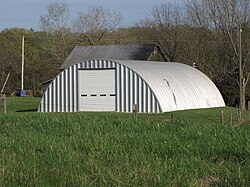
A steel building is a metal construction fabricated with steel for the internal support and for exterior cladding, as opposed to steel framed buildings which generally use other materials for floors, walls, and external envelope. Steel buildings are used for a variety of purposes including storage, work spaces and living adaptation. They are classified into specific types depending on how they are used.
History [edit]
Steel buildings first gained popularity in the early 20th century. Their use became more than widespread during World War 2 and significantly expanded after the state of war when steel became more bachelor. Steel buildings have been widely accustomed, in part due to cost efficiency. The range of application has expanded with improved materials, products and pattern capabilities with the availability of reckoner aided design software.[ citation needed ]
Advantages [edit]
Steel provides several advantages over other building materials, such as wood:
- Steel is structurally sound and manufactured to strict specifications and tolerances.
- Whatever excess material is 100% recyclable.
- Steel does non easily warp, buckle, twist or curve, and is therefore easy to modify and offers design flexibility. Steel is as well easy to install.
- Steel is cost constructive and rarely fluctuates in price.
- Steel allows for improved quality of construction and less maintenance, while offering improved prophylactic and resistance.[ clarification needed ]
- With the propagation of mold and mildew in residential building, using steel minimizes these infestations. Mold needs moist, porous material to grow. Steel studs practice non have those problems.[1]
Disadvantages [edit]
- Rut electrical conductivity: Calculations show that the web of an 18-gauge steel stud is almost 31 times thinner than a "two-by" wood stud; nevertheless, steel conducts heat 310 times more efficiently than wood. As a net result, a "two-past" steel stud volition conduct ten times more heat than a "2-past" wood stud.[2]
- Corrosion: Faulty pattern leads to the corrosion of iron and steel in buildings.[iii]
- Can bend in fires.
Types [edit]
Some common types of steel buildings are "straight-walled" and "arch," or Nissen or Quonset hut.[4] Further, the structural blazon may be classed as clear span or multiple span. A clear span edifice does not have structural supports (eastward.yard. columns) in the interior occupied space.
Straight-walled and arch type refer to the outside shape of the edifice. More generally, these are both structural arch forms if they rely on a rigid frame structure. However, curved roof structures are typically associated with the arch term.
Steel arch buildings may exist price efficient for specific applications. They are unremarkably used in the agricultural industry. Directly-walled buildings provide more usable space when compared to curvation buildings. They are also easier to blend into existing architecture. Straight-walled buildings are commonly used for commercial, industrial, and many other occupancy types.
Clear span refers to the internal structure. Clear span steel buildings use large overhead back up beams, thus reducing the need for internal supporting columns. Clear bridge steel buildings tend to be less cost efficient than structures with interior columns. However, other applied considerations may influence the selection of framing style such as an occupancy where interior structural obstructions are undesirable (e.chiliad. shipping hangars or sport arenas).[5]
Long Bay buildings are designed for employ in bay spans of over 35'. They utilise prefabricated metal frames combined with conventional joists to provide larger openings and clearances in buildings.
Components [edit]
Building portions that are shop assembled prior to shipment to site are usually referenced as prefabricated. The smaller steel buildings tend to exist prefabricated or uncomplicated enough to be synthetic by anyone. Prefabrication offers the benefits of existence less costly than traditional methods and is more environmentally friendly (since no waste matter is produced on-site).[6] The larger steel buildings require skilled construction workers, such as ironworkers, to ensure proper and safe assembly.[7]
There are five main types of structural components that make up a steel frame - tension members, compression members, bending members, combined strength members and their connections. Tension members are usually constitute as spider web and chord members in trusses and open web steel joists. Ideally tension members carry tensile forces, or pulling forces, simply and its end connections are assumed to be pinned. Pin connections prevent whatsoever moment(rotation) or shear forces from being applied to the member. Compression members are also considered as columns, struts, or posts. They are vertical members or web and chord members in trusses and joists that are in compression or being squished. Angle members are likewise known as beams, girders, joists, spandrels, purlins, lintels, and girts. Each of these members have their own structural awarding, but typically angle members will behave bending moments and shear forces equally primary loads and centric forces and torsion every bit secondary loads. Combined force members are unremarkably known as axle-columns and are subjected to bending and axial compression. Connections are what bring the unabridged edifice together. They join these members together and must ensure that they function together as one unit.[8]
See too [edit]
- Commercial modular structure
- History of the steel industry (1970–present)
- Metal Edifice Manufacturers Association
- Sheet metallic
- Steel producers
- Structural steel
- Cocky-framing metallic buildings
External links [edit]
- IAS AC472 faqs
References [edit]
- ^ "Manufacturing Business concern With Steel Building".
{{cite web}}: CS1 maint: url-condition (link) - ^ "Steel Framing: Meeting California's Residential Energy Efficiency Standards". Spider web.annal.org. Archived from the original on 2007-02-10. Retrieved 2009-10-14 .
- ^ "NRC Constitute for Enquiry in Construction - IRC - NRC-CNRC". Irc.nrc-cnrc.gc.ca. 2009-10-02. Archived from the original on 2009-02-17. Retrieved 2009-10-14 .
- ^ "The 3 Types of Steel Buildings". SteelBuildings.org. Retrieved vii May 2013.
- ^ "Metal Building Frame Types". BuckSteel.com. Retrieved 4 May 2015.
- ^ "Prefabricated Building Construction Systems Adopted in Hong Kong" (PDF) . Retrieved 24 June 2015.
- ^ Armstrong, Robert (5 December 2011). "Steel Building Kits : Erecting the Frame". Absolute Steel. Retrieved 11 October 2014.
- ^ Geschwindner,L.F.:Unified Design of Steel Structures pages iii-7
DOWNLOAD HERE
Posted by: margarettheranded.blogspot.com


0 Komentar
Post a Comment